
Designing AI Agent Orchestration
How orchestration design shapes control and coordination in multi-agent systems, and how it influences the way agents execute tasks and the outcomes systems produce

Agentic systems seem to be everywhere now, but, when creating complex multi-agent systems, ensuring that each individual agent is well-designed is not enough. We also need to design an effective agent orchestration layer that allows agents to combine their capabilities and successfully execute complex tasks.
Agent orchestration focuses on the control and coordination mechanisms that multi-agent systems need. It affects how agents reason, use tools, and interact with each other, external systems, and users. We have to understand the fundamentals of agent orchestration to get good results. Otherwise, we won’t get the outcomes we want, no matter how powerful each agent is.
Agentic systems typically require two types of orchestration: inter-agent orchestration, which coordinates work between multiple agents, and intra-agent orchestration, which manages the internal workflow within an agent.
This post is about inter-agent orchestration. It builds on ideas covered in my previous posts about agent harnesses and optimizing the agent’s environment, which focus more on individual agents.
I recommend checking those out if you want to dive further into this topic.


What Is AI Agent Orchestration
AI agent orchestration is the control layer within a multi-agent system’s architecture responsible for coordinating agents. In multi-agent systems, we can break down complex workflows into distinct tasks and assign each one to specialized agents. Each agent is equipped with custom instructions, knowledge, tools, and permissions suited to specific tasks, making it more likely to complete them successfully. However, multi-agent systems need well-designed orchestration to work effectively. Otherwise, the system may use the wrong agents, use the right agents incorrectly, or coordinate agents inefficiently, leading to suboptimal, poor, or outright bad outcomes.
How Is AI Agent Orchestration Different From AI Orchestration?
The agent orchestration layer sits within the AI orchestration layer, which is responsible for managing the entire AI system. The agent orchestration layer is specifically responsible for managing agents. It ensures that work can be efficiently divided between agents, so that complex, multi-step tasks can be completed more reliably, effectively, and efficiently. It does not manage broader system-level operations, such as model routing, data pipelines, governance policies, security guardrails, monitoring, and so on.
Where AI orchestration optimizes execution paths, AI agent orchestration manages intent-driven systems in which agents dynamically break down goals, negotiate task ownership, and adjust strategies as new information emerges.
— GitHub, What is AI agent orchestration?
What Are The Key Concepts In Agent Orchestration?
There are two key concepts to understand when working with agent orchestration: orchestration models and orchestration patterns.
The orchestration model defines who is in charge. It’s the control mechanism that governs how agents are managed. It determines how responsibility is distributed within the system. A single system typically uses a single model, even if it may use multiple patterns. The same orchestration pattern can behave differently depending on the system’s orchestration model.
The orchestration pattern defines how work gets done. It’s the coordination mechanism that governs how agents interact to complete a workflow. It determines execution details, such as agent routing, task order, state management, and failure handling. A single system can use multiple patterns depending on task complexity and desired outcomes.
Choosing how to design your agent orchestration is perhaps the most consequential architectural decision when building a multi-agent system because it impacts how the entire system behaves and what outcomes it produces.
How Does AI Agent Orchestration Work?
Here’s how the agent orchestration layer in a multi-agent system works:
Task Decomposition: When assigned a high-level task, the orchestration layer first identifies what needs to be achieved, what constraints apply, and what success looks like. Once these details are identified, the high-level task is broken down into discrete subtasks (scoped for the available agents), and the overall workflow is planned.
Agent Selection: Subtasks are divided between agents based on task complexity and the agent’s capabilities. Each agent is given relevant context. Depending on the orchestrator design and the task execution order, some agents may be assigned tasks sequentially, while others work in parallel.
Task Execution: Agents work on their specific tasks. The orchestration layer monitors progress, validates outputs (often using deterministic checkpoints), and passes them onto subsequent steps at the right time. It handles failures or unexpected outputs at each step. In some implementations, it may also call additional agents as required.
Human-In-The-Loop: The orchestration layer escalates certain high-risk actions for human review (e.g., destructive changes, financial transactions, production changes). This ensures that humans stay in control where it matters most, so agents aren’t executing critical or consequential operations without oversight or approval.
Completion: Once the workflow is complete, the orchestration layer triggers a predefined completion action (e.g., notifying users, generating logs, storing outputs). In some workflows, it may need to compile or process the agents’ final output for safety, reliability, or quality reasons.
Basic Agent Orchestration Models
The orchestration model defines how responsibilities are managed across the system, determining how all patterns within it behave.
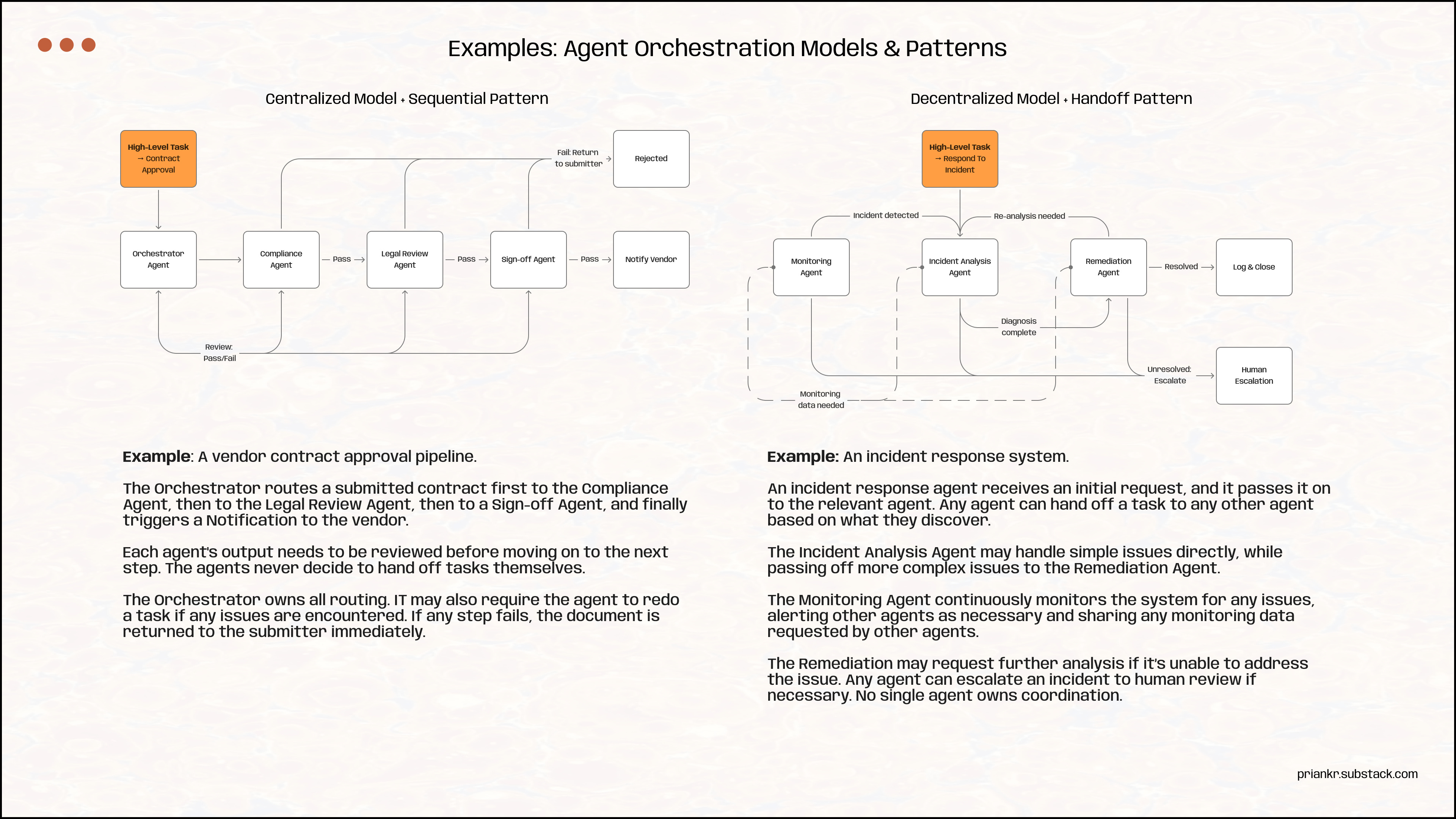
Centralized
In a centralized model, a primary orchestrator agent delegates tasks to specialized agents. It’s responsible for planning, routing, and supervising. This is the most commonly used model because of its relative simplicity. However, the orchestrator agent can also become a bottleneck as complexity grows if it can’t continue to efficiently and correctly delegate tasks.
Typical Use Case: Structured workflows with clearly defined tasks and predictable routing.
Decentralized
In a decentralized model, multiple agents coordinate to execute workflows by handing off tasks to one another. One agent may either fully take over certain tasks from another or hand them back after completing a specific operation. Agents share context and coordinate task routing based on predefined rules defining peer-to-peer coordination. This model is often more scalable and resilient since there isn’t a single point of failure or bottleneck. However, the coordination logic is typically more complex, so it requires more sophisticated state management and monitoring.
Typical Use Case: Highly distributed systems requiring fault tolerance.
Federated
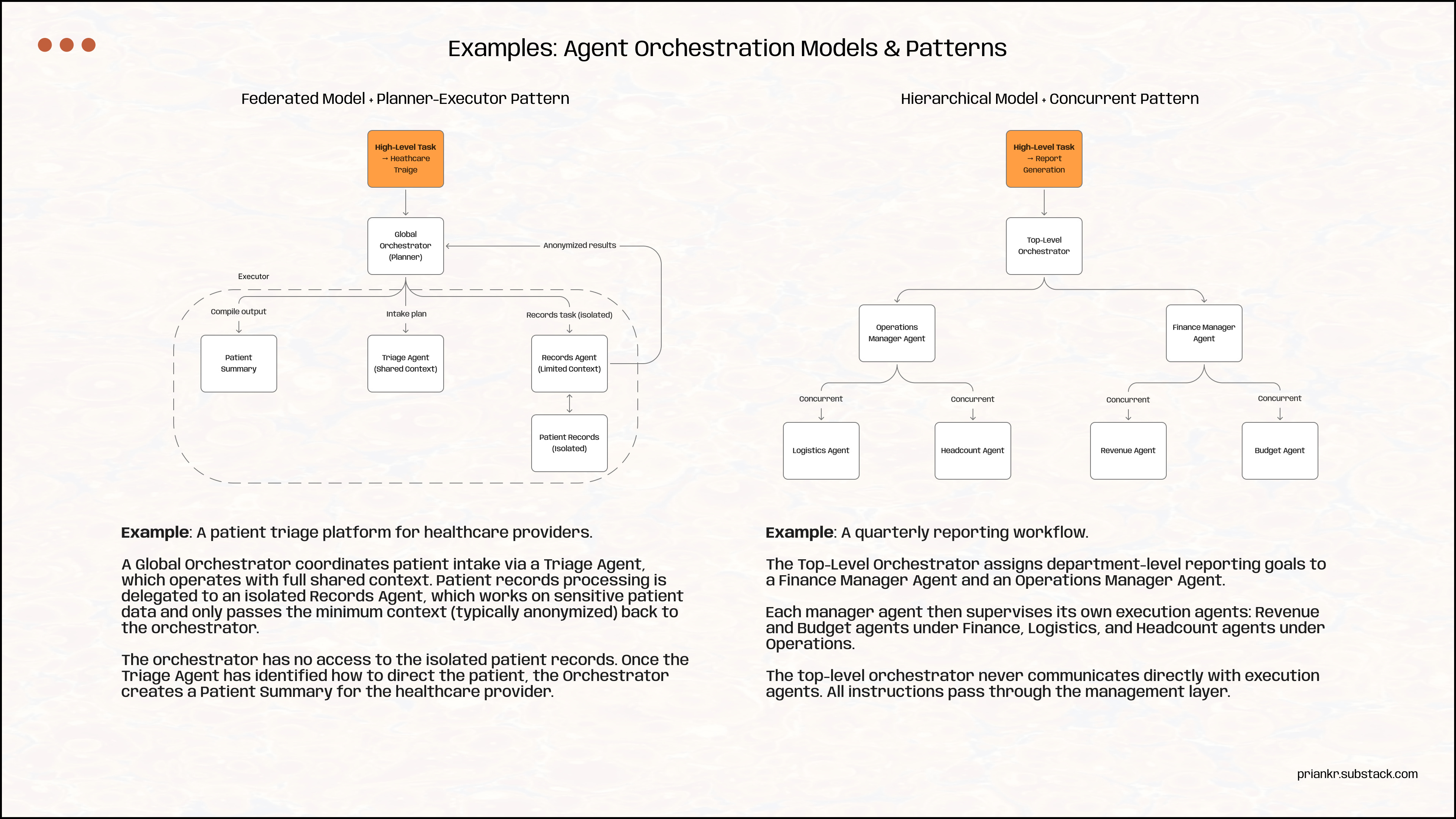
In a federated model, agents or groups of agents collaborate on tasks semi-independently, without fully sharing context and control over their individual tasks. It combines centralized control with decentralized execution. This is ideal when some tasks still need to be isolated from others (e.g., tasks involving sensitive data). There are global rules defining how the agents or agent groups coordinate the overall work.
Typical Use Case: Systems spanning organizational or trust boundaries where some tasks require isolation.
Hierarchical
In a hierarchical model, an orchestrator agent (or manager agent) sets goals and delegates to subordinate agents. Each subordinate agent may supervise their own agents as well. This creates a multi-level command chain of agents. Workflows are coordinated by passing information up and down the chain. Work can be done in parallel within each level, improving latency. However, cost and complexity can rapidly increase as the number of agents involved grows, so coordinating agents efficiently becomes critical. Each level needs specific guidance and context. If the hierarchy becomes too rigid, it can also become harder to adapt to new scenarios.
Typical Use Case: Large-scale workflows requiring subdivision into specialized sub-teams.
Basic Agent Orchestration Patterns
The orchestration pattern defines how agents work together to execute the work.
There are no “standard” naming conventions for the different orchestration patterns. In some contexts, the same pattern may have different names, or different patterns may be considered more or less the same because of how they are implemented. It’s often more helpful to focus on the distinctions in the mechanism rather than the specific names.
Sequential
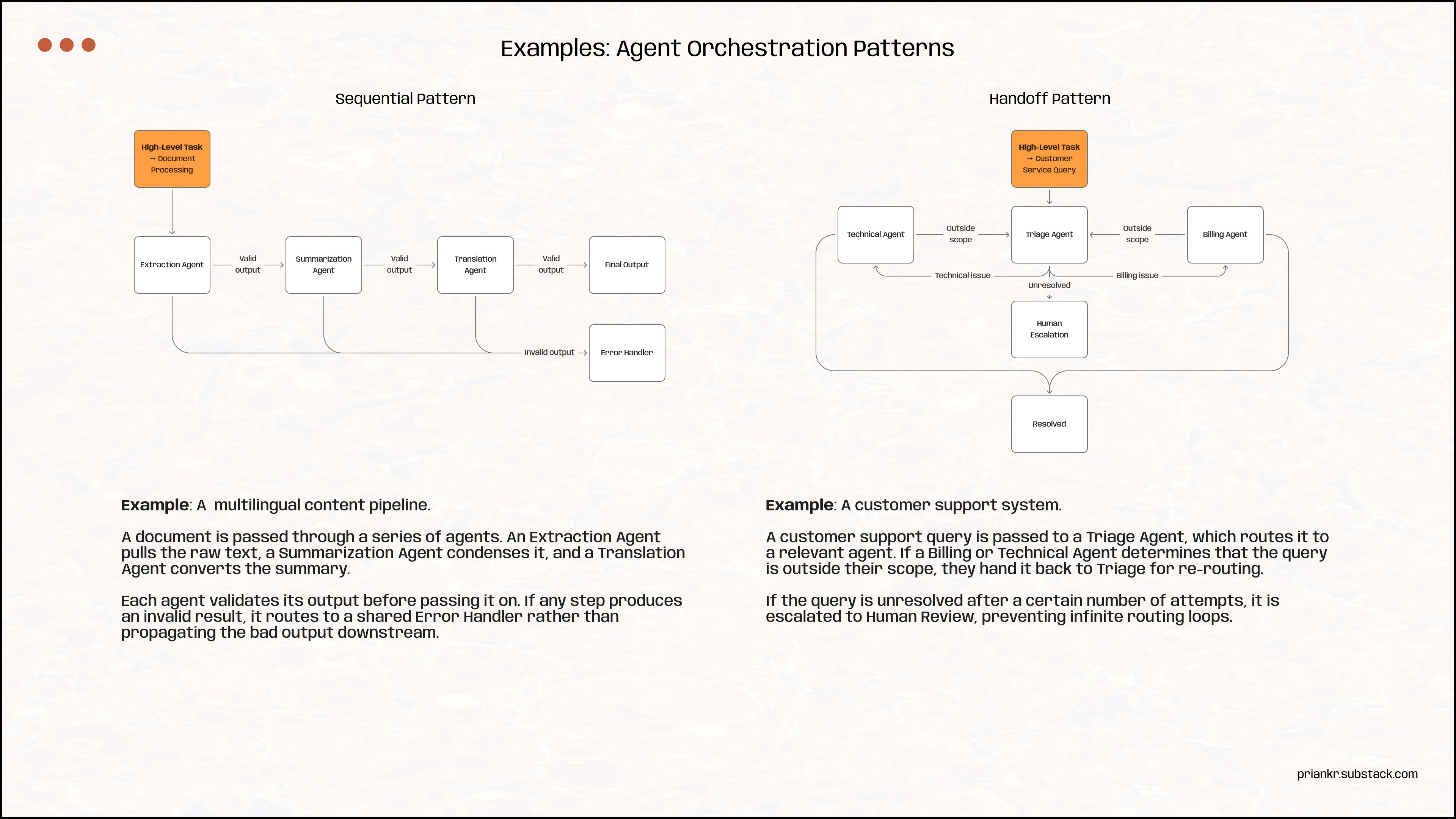
In a sequential pattern, tasks are routed between agents in a fixed order. Each agent’s output becomes the next agent’s input. This pattern is the simplest and most predictable, making it easy to implement and debug. However, the sequential nature also means that failures can compound between steps if there are no robust validation checks to review outputs before passing them on. It’s also slower than other patterns.
Typical Use Case: Linear workflows where each step depends on the output of the previous one.
Handoff
In a handoff pattern, agents dynamically delegate tasks to other specialized agents. Each agent decides whether to handle a task directly or transfer it to another agent based on the context and requirements. This works best for scenarios where dynamic routing between specialized agents is needed, but it may not always be clear upfront which agent is the best choice for a task. However, there’s a risk of infinite routing loops, where tasks keep getting handed back and forth between agents (Agent A ↔ Agent B), so guardrails are necessary, such as maximum handoff limits, timeout thresholds, and automatic escalation after a certain number of transfers.
Typical Use Case: Variable workflows requiring dynamic routing between specialized agents.
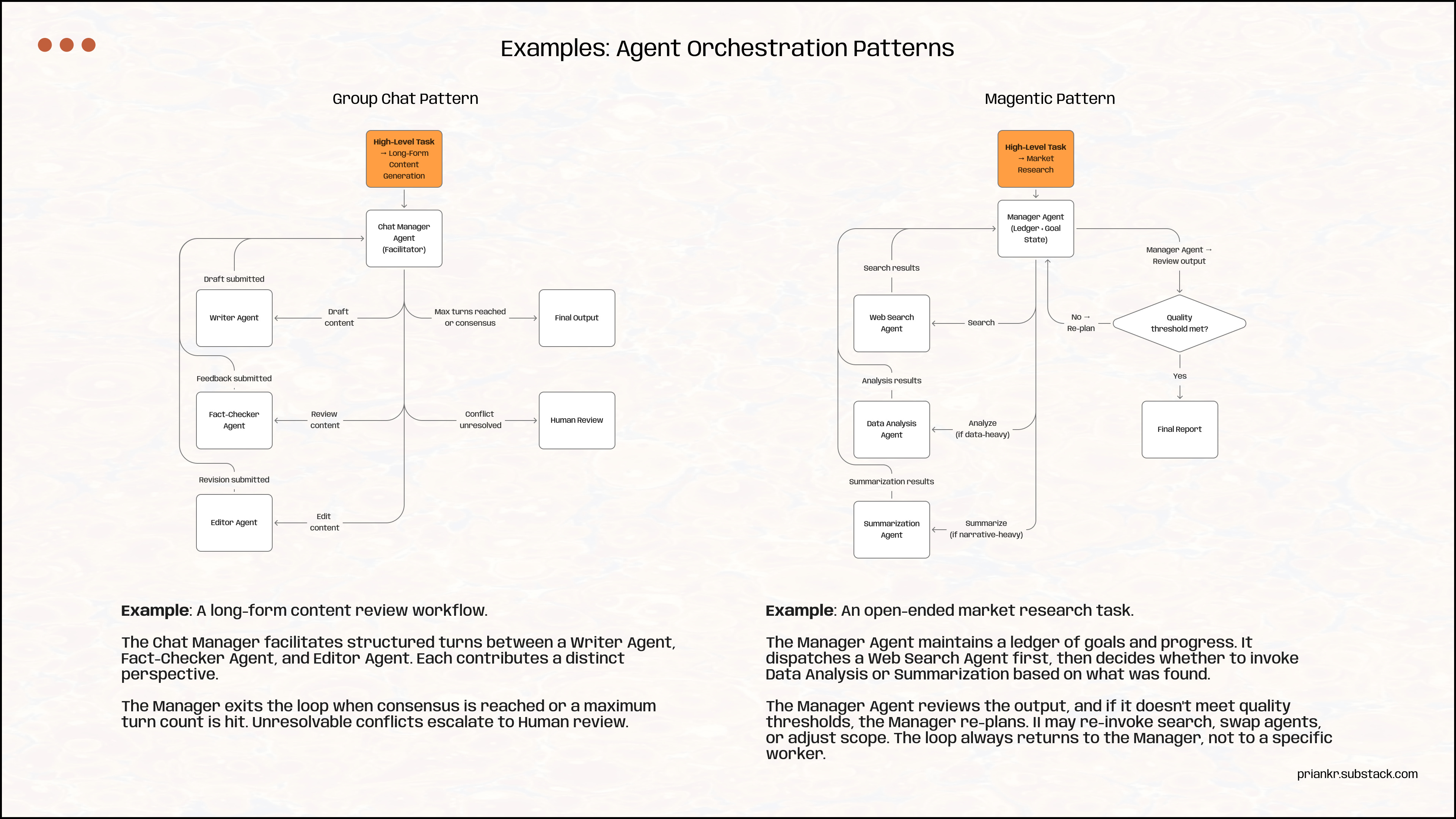
Group Chat
In a group chat pattern, an orchestrating agent (or chat manager agent) facilitates a structured discussion between specialized agents. The manager agent guides conversations toward productive outcomes, allowing agents to collaborate on tasks. The agents share context, exchange ideas, and contribute toward decisions, exploring options before arriving at an answer. However, agents can loop indefinitely without converging on a solution, so guardrails are necessary to prevent this scenario, such as a maximum number of discussion turns or a default resolution rule for conflicts.
Typical Use Case: Complex problems requiring multiple perspectives.
Magentic
In a magentic pattern, an orchestrator agent (or manager agent) dynamically plans execution based on goals and requirements using a ledger-based planning approach. The manager agent communicates directly with specialized agents to monitor and manage execution. It gathers information from agents and makes adjustments if necessary, instructing agents to redo tasks if they do not pass quality or validation thresholds. Since agents are “pulled” into the process as needed, it’s highly flexible and adaptive. However, this pattern requires advanced orchestration logic, which often makes it hard to implement and debug.
Typical Use Case: Dynamic workflows where the task complexity or required agents cannot be fully determined upfront.
Concurrent
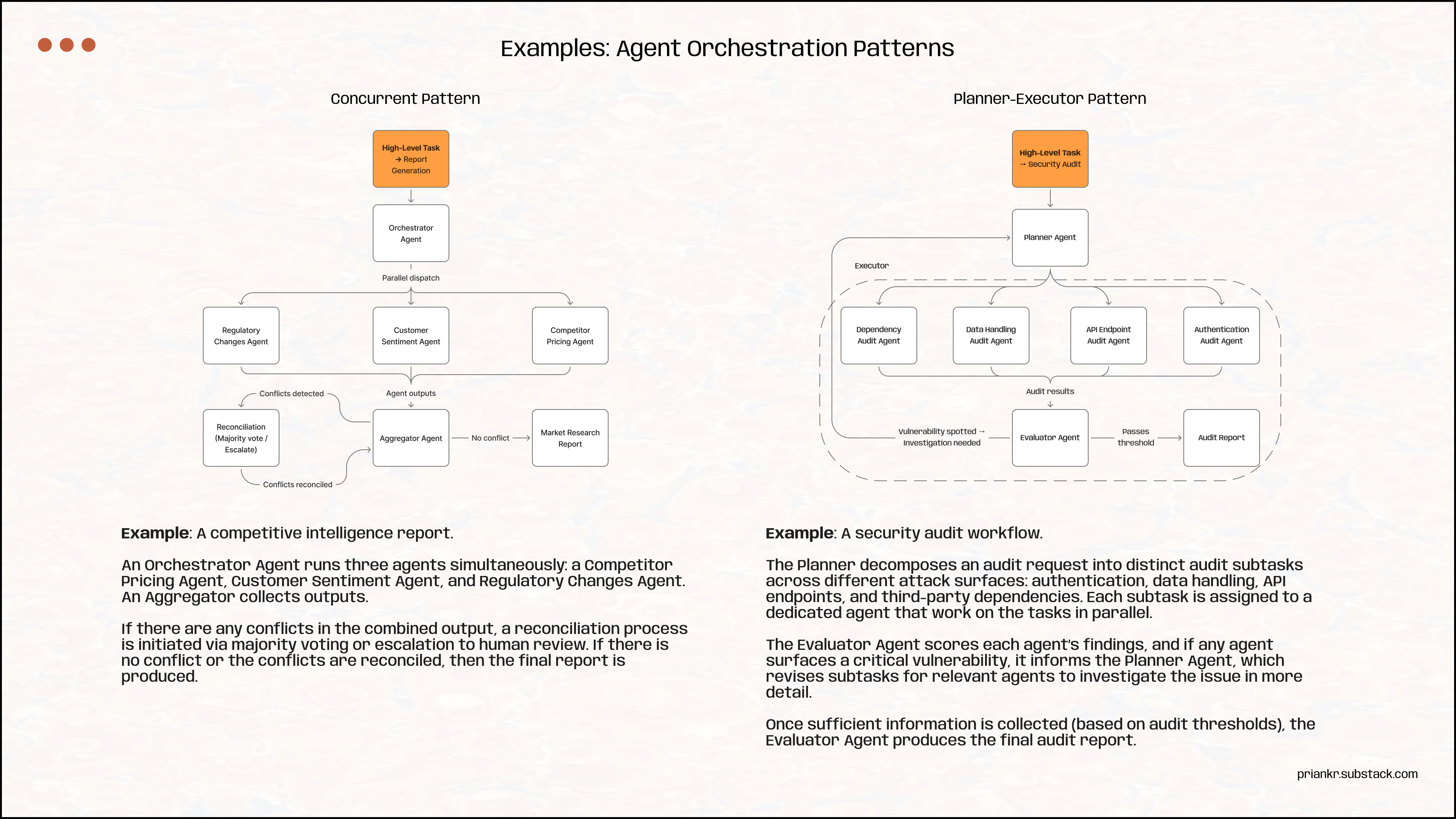
In a concurrent pattern, an orchestrator agent splits tasks into multiple parallel subtasks assigned to independent agents and aggregates their outputs. Parallel processing can reduce overall latency, and it also lets us compare multiple potential solutions to a problem simultaneously. However, there are higher computational costs, and the agents can also produce conflicting outputs, so there needs to be clearly defined reconciliation rules (e.g., majority voting, confidence scoring, or escalation to human review). It’s also harder to debug when something goes wrong.
Typical Use Case: Workflows with independent subtasks that can be executed simultaneously.
Planner-Executor
In a planner-executor pattern, an orchestrator agent (or planner agent) creates an execution plan, defining what needs to be done, while specialized execution agents execute the workflow. The planner agent will break down complex tasks into manageable subtasks, assign them to relevant agents, and reconcile the results. Agents may handle tasks sequentially, in parallel, or through a hybrid approach. In some versions of this pattern, a separate evaluator agent scores the output against quality thresholds and sends structured feedback to the planner if thresholds are not met. The planner then revises its plan and assigns new subtasks to agents. However, if the planner agent fails to catch errors between steps, errors can propagate, so reliable error handling and validation checks are necessary.
The Planner-Executor is closer to an orchestration model than a pure orchestrator pattern. It’s similar to the hierarchical model since a primary orchestrator defines a plan for other agents to execute. The main difference is that when breaking down the high-level task, the orchestrator creates an explicit plan when assigning tasks, which it may revise based on the agent’s outputs. This makes it especially useful for open-ended tasks, where it may not be clear how the subagents must be used. However, in some implementations, it’s essentially the same as the hierarchical model.
Typical Use Case: Complex workflows where tasks are not fully defined upfront and benefit from explicit decomposition before execution.
Designing Orchestration For A Multi-Agent Workflow
The orchestration model and pattern should augment the system’s strengths without introducing unnecessary complexity. The “best” choice depends on your quality thresholds, performance requirements, and risk tolerance, which will vary based on your product’s specific use case. Simpler orchestration is usually a better choice than a more complex one.
Map Out The Workflow
Outline each step in the workflow, documenting inputs, outputs, decisions, dependencies, and potential failures. Visualize the specific steps that the system will need to execute, while carefully considering how predictable, consistent, and deterministic the overall workflow is. Highly variable workflows will need different orchestration from less variable ones.
Define Agent Roles & Coordination Requirements
Each agent should serve a distinct purpose. It should have a clear role, specific tools, and well-defined instructions. Consider the capabilities and constraints of each agent and identify how they will need to interact with each other. Depending on the workflow’s structure, agents may need to coordinate in different ways. The coordination requirements should inform decisions about the model and patterns to implement.
Identify The Right Model & Pattern
Once we understand the workflow and the required agent coordination, we can evaluate which models and patterns work best for our use case. Consider the required routing logic, handoff rules, and fallback paths. Also test how different implementations handle failures (e.g., bad outputs, timeouts, routing issues). Depending on our goals and priorities, the same workflow may require a different implementation to balance cost, performance, and quality trade-offs. Often, it can take some experimentation to identify the right one because many inefficiencies and quality issues aren’t apparent immediately.
Here is an example illustrating how you might pick an orchestration model and an orchestration pattern.
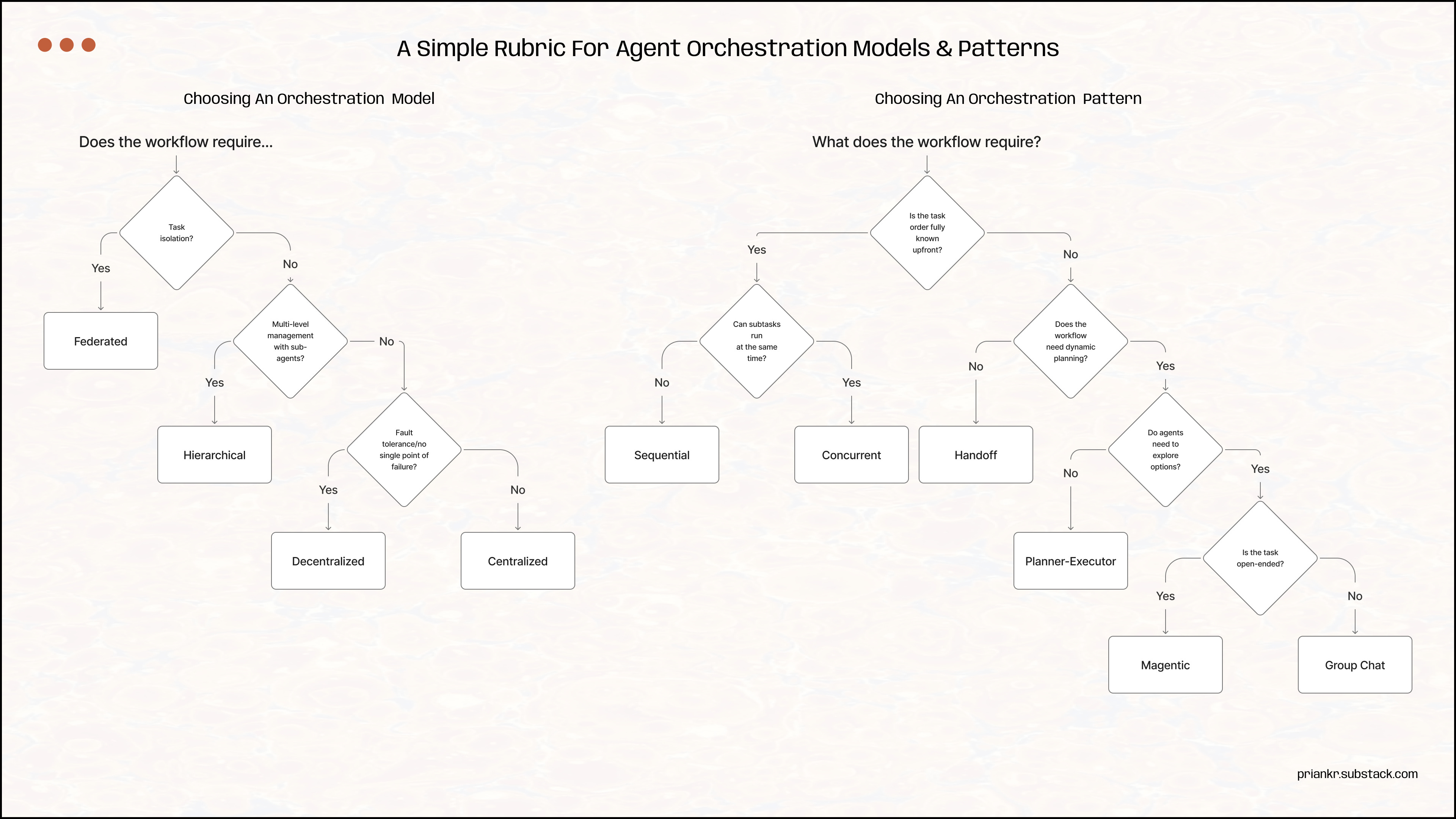
When you’re working on complex tasks, you may need to combine multiple patterns in ways that don’t neatly align with any single “standard” implementation. The decision tree above is most applicable for relatively simple, straightforward scenarios, but it can help you understand how to think about designing multi-agent systems.
Add Observability
Observability data can help us understand how effectively our system operates. The orchestration layer can log every agent’s inputs, outputs, and actions, as well as the overall workflow outcomes. The logs should capture agent-specific details, such as token usage, latency, tool calls, task success rate, error rates, and cost per execution. This data can be incredibly useful for debugging issues or evaluating workflows, since it can reveal failures and inefficiencies. In many cases, it can also create an audit trail, which may be necessary for compliance and incident investigation when something goes wrong.
Conclusion
As workflows grow more sophisticated and involve more agents, orchestration design decisions directly affect how multi-agent systems manage quality, risk, and failure. A system with highly capable agents but poor orchestration will very likely underperform. Without clear, structured control and coordination mechanisms, there are just many more chances for things to go wrong as tasks and context pass from agent to agent.
Agent orchestration is still evolving as both the underlying AI models get more powerful and builders learn more about how to implement them. New orchestration patterns and models will emerge as builders encounter problems that need different approaches. Orchestration will become a more valuable lever for improving system performance as agents grow more capable, since it determines how much of that capability the system can actually use.
Thanks For Reading
If you haven’t already, please consider subscribing to this newsletter. I hope you have a great week!
References
Priank’s Newsletter
Dataiku | Agent orchestration explained: how enterprises manage multi-agent AI workflows
MindStudio | Multi-Agent Orchestration: How to Build Agent Teams That Actually Work
Product School | AI Agent Orchestration Patterns for Reliable Products
Redis
Snowflake | AI Agent Orchestration: What It Is & How It Works
Wiz | AI agent orchestration: What security teams need to know