

Great solutions reflect a deep understanding of people and their problems. People want products and services that resonate with them. They want their choices to be both meaningful and practical. Solutions that fit into their unique context. When teams prioritize customer satisfaction, they deliver great experiences that build loyalty and trust.
However, getting from problem to solution is a process. Many roads can lead to the right answer. A clear framework can be a powerful tool for creating customer-centric solutions. One I have been drawn to is the Working Backwards approach pioneered at Amazon, which has been instrumental in their success. It changes how teams tackle product development. It begins by prioritizing the customer’s needs and working backwards to create compelling solutions. It ensures that every step they take aligns with the end goal of delivering exceptional customer value.
All problems can be solved once we discover the path to a solution. The working backwards process defines what a future successful outcome will look like and the plan to get there. It’s an inherently people-centric approach to problem-solving. I would like to explore how it can help us develop better solutions.
Takeaways
Working backwards prioritizes customers throughout solution development.
It refines thinking through a structured idea assessment framework.
It creates clarity through a rigorous writing and review process.
It defines what an incredible solution might look like.
It concentrates efforts on the best ideas.
Working Backwards At Amazon
Amazon puts customers at the center of everything they do. They developed the working backwards process to prioritize what the customer wants. They believe that delivering real value to their customers ultimately translates to sustained business success.
Working Backwards is a systematic way to vet ideas and create new products. Its key tenet is to start by defining the customer experience, then iteratively work backwards from that point until the team achieves clarity of thought around what to build.
How Does It Work
Teams can refine their thinking through a structured idea assessment framework.
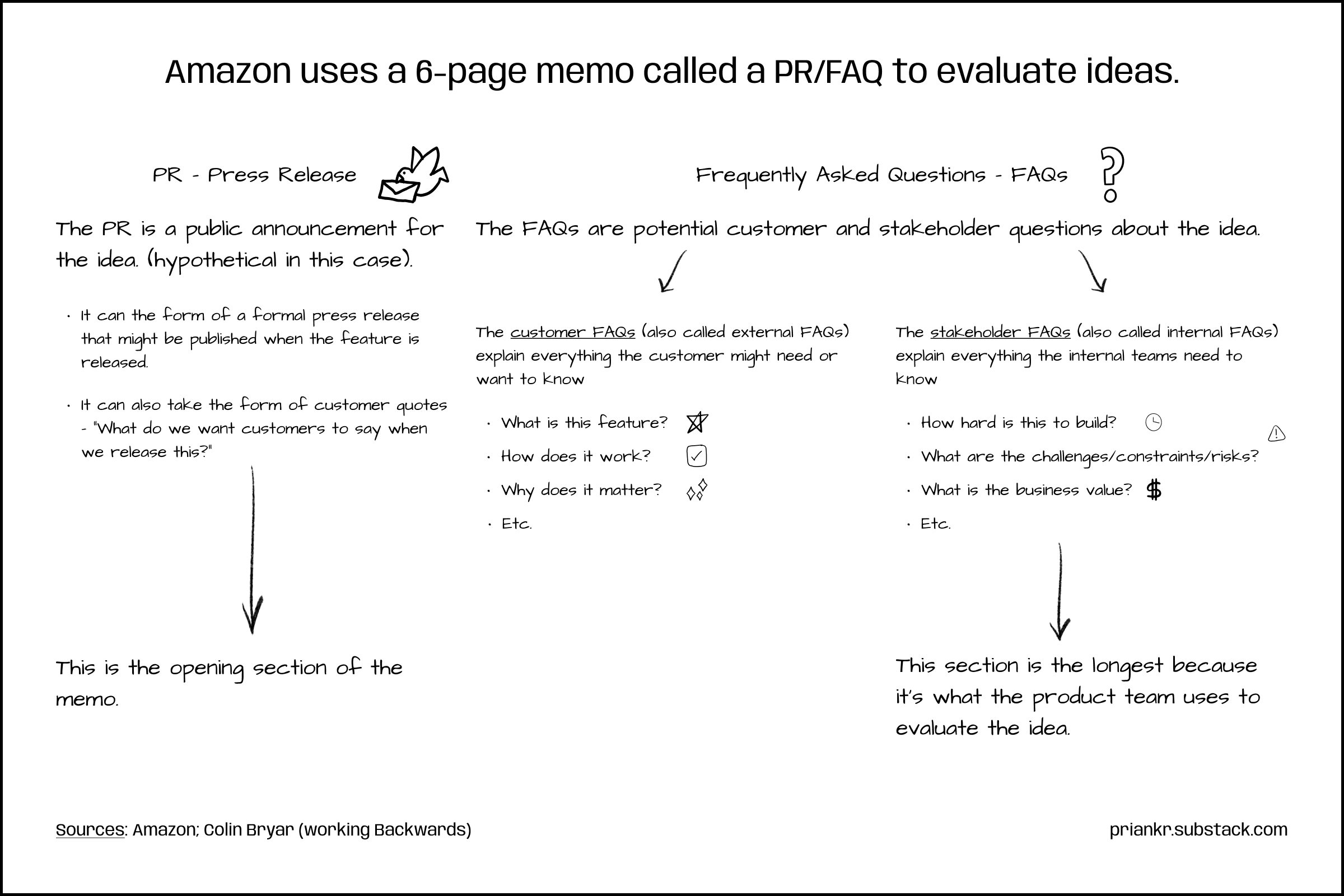
When someone has a new idea (for example, a new feature), they write a detailed document explaining what the idea is, how it benefits customers, and what needs to be done. This takes the form of a 6-page memo called a PR/FAQ (Press Release and Frequently Asked Questions).
The PR is a hypothetical press release for the idea. It imagines what a compelling announcement for the finished product looks like and how customers will respond.
The FAQs are answers to potential customer and stakeholder questions about the idea.
The customer FAQs (also called external FAQs) explain everything the customer might need to know: what is this feature, how does it work, why should they care, etc.
The stakeholder FAQs (also called internal FAQs) explain everything the internal teams need to know: how hard is this to build, what are the challenges/risks, what is the business value, etc. This section is the longest because this is what the teams use to evaluate the idea.
Check out my previous post on How Effective Writing Helps Companies Succeed for more on how Amazon benefits from their writing-driven approach.
Why Is It Effective
It creates clarity through a rigorous writing and review process.
Teams explore ideas in depth through an intensive writing and review process. They produce multiple drafts of the PR/FAQ as they iterate, debate, and refine ideas. It provides a detailed explanation of what they hope to accomplish, how they will do it, and why they will be successful. It provides stakeholders with the information needed to make an informed decision: Why should they pursue the idea? How likely are the desired outcomes? And is it worth it?
It defines what an incredible solution might look like.
Teams need an idea that’s compelling to both the customer and the organization. Developing a solution is a resource-intensive endeavor, whether your organization is big or small. You only get so many shots at acquiring a customer. Therefore, you need to build something really valuable to them. You also need to do it better than the competition. A structured and rigorous ideation process can systematically reveal what an incredible solution might look like to the customer.
It concentrates efforts on the best ideas.
Teams to put in a lot of work upfront into the process. However, it’s designed to be a filter. It’s a considered, thorough, data-driven method for deciding how and when to commit resources. While many ideas might not make it through, teams have greater confidence in the ones that do. This ensures that their efforts are focused on pursuing their best ideas.
Done correctly, the Working Backwards process is a huge amount of work. But it saves you even more work later. The Working Backwards process is not designed to be easy, it’s designed to save huge amounts of work on the backend and to make sure that we’re actually building the right thing.
What Are The Benefits
It keeps the team consistently focused on the customer: Who are they? What is their problem? Why do they care? Why and how will this solution benefit them?
It exposes potential challenges and constraints before resources are committed, which prevents costly delays, dependencies, and redevelopment down the line.
It provides a holistic picture of the potential upsides and downsides of pursuing an idea, given its inherent risk, feasibility, and likelihood of success.
It creates a strong feedback loop that creates a detailed, data-oriented method to make informed decisions and direct resources.
Parallels With Design Thinking
Both working backwards and design thinking drive decisions based on customer value.
Design thinking is a human-centered approach to problem-solving that prioritizes empathy, ideation, and experimentation. It shares many similarities with the working backwards process. Both approaches share an emphasis on understanding and prioritizing customer needs. They start with developing a deep customer understanding, identifying real problems, and creating effective solutions. The working backwards process achieves this through their PR/FAQ writing and review process, while design thinking uses prototyping and testing. Iteration based on feedback is a key characteristic of both approaches.
Check out my previous post on Designing For People for more on Design Thinking.
Conclusion
Many frameworks can empower teams to build excellent products and services. It’s important to choose one that helps you build the right things by prioritizing customers throughout the solution development process. By putting them and their desired outcomes at the center of all your work, you create solutions that reflect what they care about.
Creating customer-centric solutions is vital for the success of any product. The working backwards process gives teams a better understanding of what to build and why. It evaluates whether pursuing an idea is really worth it, regardless of how new and exciting it may seem. It enhances how you imagine, design, and build products.
While working backwards is one of many possible frameworks for solving customer problems, its core focus on aligning with what they truly need ensures products not only meet but exceed expectations.

Thanks For Reading!
If you haven’t already, please consider subscribing and sharing this newsletter with a friend.
I hope you have a great week!