

We all have products that solve a specific problem in our lives really well. When we find those solutions that just feel perfect, we usually stick with them for a long time. But how did a company figure out exactly what we needed? How did they know the right thing to build?
These are questions I often encounter while developing products. I believe that a strong focus on people is essential when solving problems. I have discovered that successful companies, like Airbnb and Netflix, use a concept called Design Thinking while building products.
Design influences everything users do, think, and feel while using a product. While people certainly care about solving their problems, great experiences give them a compelling reason to choose a specific solution. And design is how we deliver those experiences.
I decided to explore how Design Thinking helps product teams create great solutions.
What I Will Cover
What Is Design Thinking - A people-centric approach to product development.
How Do Product Teams Use Design Thinking - Teams use it to empathize with users, define problems, develop solutions, build prototypes, test, and iterate.
Design Thinking In Action - How Airbnb and Netflix use Design Thinking
Why Is Design Thinking Valuable - Teams can gain context on people’s lives, uncover hidden needs, translate metrics into people-centric outcomes, and build the right things.
Takeaways For Product Teams
Conclusion
What Is Design Thinking
Design Thinking is a people-centric approach to product development.
Design thinking is a process used to understand users, define meaningful problems, and create impactful solutions. It reveals the full context of people's lives. It helps teams build a better product by focusing on the people who it’s designed for.
Design Thinking Isn’t Just For Designers
Design does not exist in a vacuum. All product functions contribute to the user’s experience in some way. Therefore, a well-designed product needs to combine great design with great technology, great delivery, great messaging, etc.
Design Thinking puts the user at the center of every decision in the solution development process. Team members are not just thinking about the product’s look and feel. They are imagining the user’s perspective to figure out how they can improve the user’s experience. They assess what they need to build and why to ensure that they make things that people will actually use.
How Do Product Teams Use Design Thinking
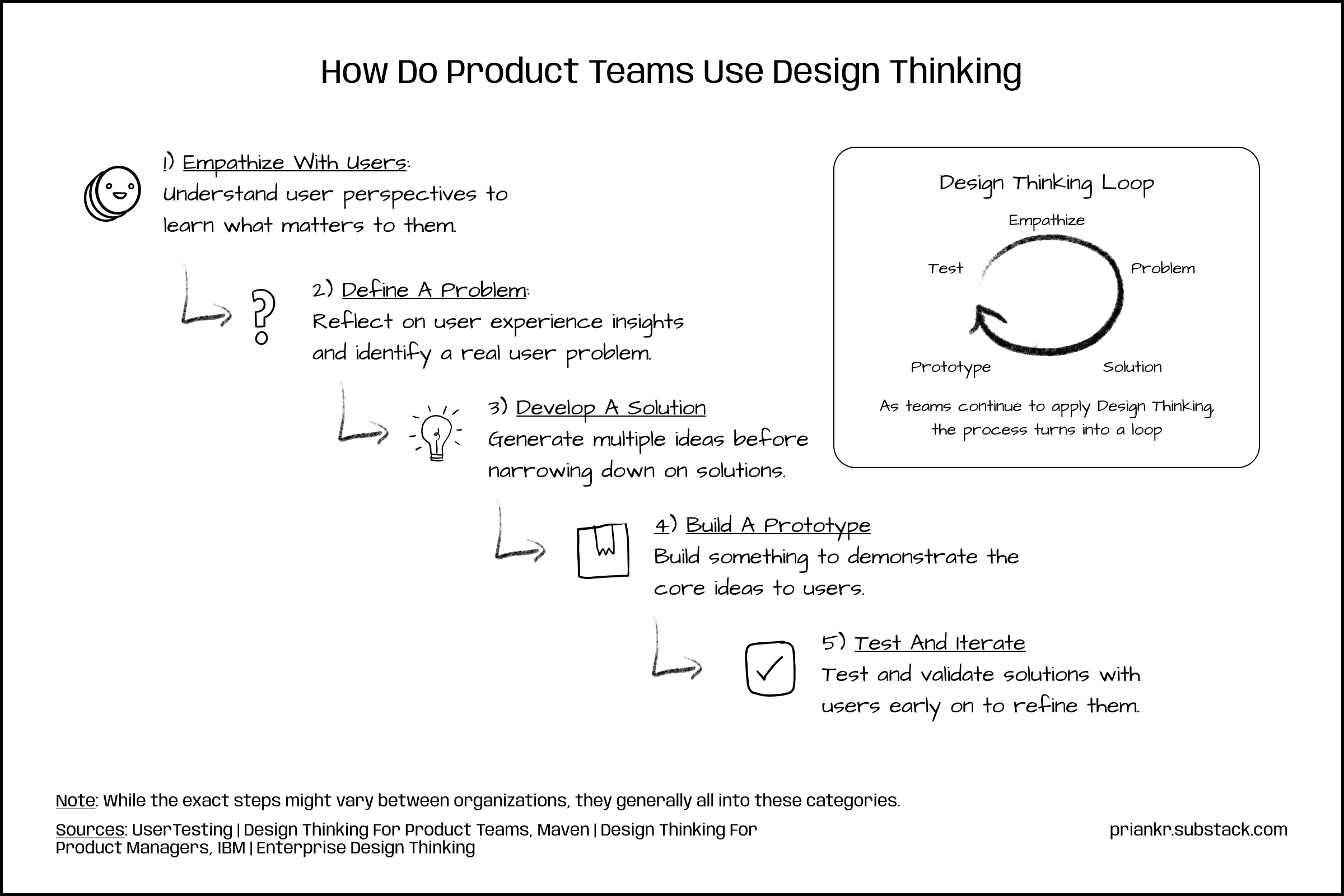
Design Thinking is a human-centric approach to problem-solving and product development. While the exact steps might vary between organizations, we can broadly categorize them as follows: Empathize With Users, Define A Problem, Develop A Solution, Build A Prototype, and Test And Iterate.
Empathize With Users
Understand user perspectives to learn what really matters to them.
We use empathy to understand people’s experiences from their perspective, rather than our own. It involves understanding our users’ needs, observing their behaviors, and uncovering their challenges. The focus is on gaining context on people’s actions, thoughts, and feelings through various methods, such as interviews, observations, and surveys.
Define A Problem
Reflect on user experience insights (the “aha” moments) and identify a real user problem.
By recognizing the moments of frustration users experience, we can establish what needs to be done and why. We should define a people-centric problem that is valuable to the customer and the business to justify the commitment of time, energy, and resources. While solving the problem should be worth it for the business, the primary goal is still to address a real user need.
Develop A Solution
Generate multiple ideas before narrowing down on solutions.
A well-defined problem gives us a clear target to aim for when thinking about possible solutions. We should involve as many people as possible while generating ideas. People with different contexts can help us see new perspectives. The goal is to generate as many ideas as possible before narrowing down the best prospects (based on constraints, feasibility, impact, etc.).
Build A Prototype
Build something to demonstrate the core ideas to users.
Prototyping allows us to evaluate ideas by giving people something real to interact with, which also makes it easier for them to give feedback. Prototypes don’t have to be refined or complex. They should just demonstrate the basic concepts of our solution by helping the user accomplish a specific task (related to their problem). It can take various forms, such as wireframes, mockups, etc.
Test And Iterate
Test and validate solutions with users early on to refine them.
Prototype testing allows teams to get user feedback to validate assumptions, identify issues, and refine ideas, before committing to further development. It is vital to identify when we are going off track, so we can minimize (or hopefully eliminate) costly corrections and rework down the line. This ensures that our efforts are concentrated on the most valuable work.
As teams continue to apply Design Thinking, the process turns into a loop.
Design Thinking In Action
Airbnb
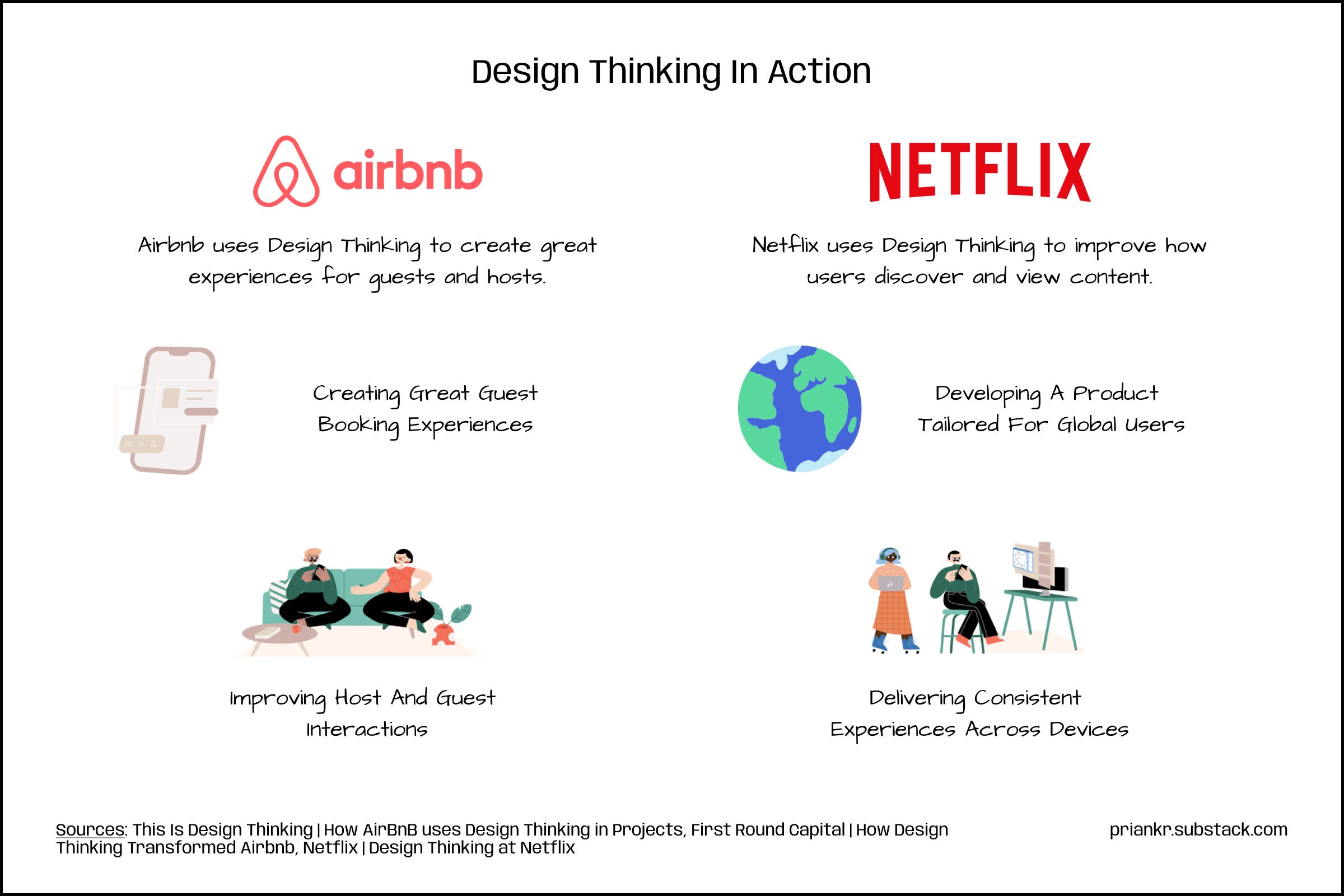
Airbnb uses Design Thinking to create great experiences for guests and hosts.
Airbnb is a two-sided marketplace that matches guests looking for places to stay with hosts providing those spaces. They use Design Thinking to create a more intuitive and user-friendly platform, which has played a critical role in their success.
Improving Guest Booking Experience
In 2009, Airbnb was struggling to grow their platform. After examining their guest’s booking process, they realized that poor-quality photos were making it hard for guests to judge what they were paying for. The team decided to replace the photos with high-quality images to reduce guest hesitation, which resulted in a significant increase in revenue. It demonstrated the value of empathizing with users, which has since become a core part of their mindset.
Reducing Booking Rejections
Sometimes the expectations of guests and hosts don’t align, which results in hosts rejecting guests. For example, a host in a quiet neighborhood might not want seemingly loud guests (young people, tourists, etc.). The team investigated the host's perspective through surveys and interviews. They discovered that hosts wanted to feel confident that the guests would treat them and their properties well. They used their insights to improve the booking experience for both sides, leading to higher trust and confidence between hosts and guests, which reduced their booking rejections.
Netflix
Netflix uses Design Thinking to improve how users discover and view content.
Netflix is the world’s largest content streaming service with over 270 million users globally. Design Thinking influences how they create experiences that help their users discover what to watch, which has contributed to their massive global reach.
Designing For A Global Audience
Netflix believes in building a global product, even though their users around the world have different ways of thinking. While there are regional variations in the app, they are selective when tailoring for individual markets. When they create new features, they research the regional and cultural context to evaluate what aspects are worth customizing. They test ideas frequently and use quantitative and qualitative feedback to understand what people are doing and why. They use these insights to narrow down the exact elements that need to be customized.
Catering To Experiences Across Devices
Netflix realized that users interact with their app on many platforms (TV, Mobile, Tablets, etc.). They have discovered that even subtle changes (like the design of buttons) can influence what actions users will take. For example, when creating features for their mobile app they consider how a person might hold their phone and what actions seem intuitive and logical. They evaluate how users behave across devices to identify where they are failing to meet expectations. They test and refine before releasing new features to ensure a great and consistent experience across devices.
Why Is Design Thinking Valuable
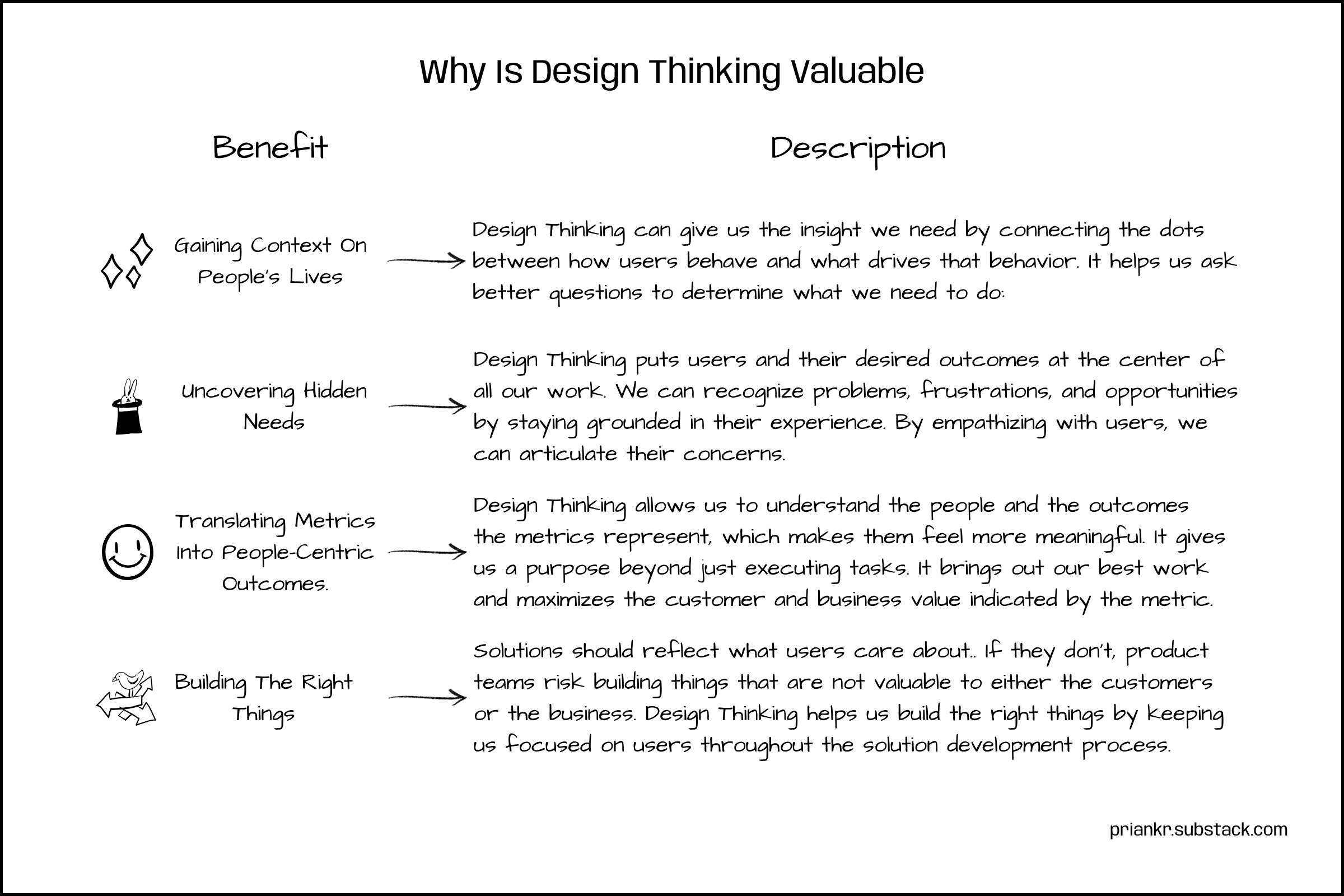
Gaining Context On People’s Lives
We need a deep understanding of people and their problems to build a good solution. We should recognize what’s meaningful to them and what motivates them. To move in the right direction, we need the full context of the users’ lives.
Design Thinking can give us the insight we need by connecting the dots between how users behave and what drives that behavior. It helps us ask better questions to determine what we need to do: What customer problem are we solving? Why is it valuable to them? Why is it worth solving?
Uncovering Hidden Needs
Sometimes people struggle to explain their problems. Teams need to figure out what customers want to do, how they might want to do it, and what their motivations are. Once they can determine these things, they can start exploring the opportunities they can address.
Design Thinking puts users and their desired outcomes at the center of all our work. We can recognize problems, frustrations, and opportunities by staying grounded in their experience. By empathizing with users, we can articulate their concerns.
Translating Metrics Into People-Centric Outcomes.
Businesses usually have clear metrics to define success (annual revenue, active users, etc.). While metrics are great for setting targets and evaluating progress, they don’t always tell the story of the people we are building products for.
Design Thinking allows us to understand the people and the outcomes the metrics represent, which makes them feel more meaningful. It gives us a purpose beyond just executing tasks. It brings out our best work and maximizes the customer and business value indicated by the metric.
Building The Right Things
Many useful features lay unused and undiscovered in the products we use because sometimes solving a problem well is not enough. Product teams might spend time identifying a meaningful problem and building a great solution. However, if people don’t end up using it, they have invested time, effort, and resources in creating something that failed to produce a return.
Solutions should reflect what users care about. If they don’t, product teams risk building things that are not valuable to either the customers or the business. Design Thinking helps us build the right things by keeping us focused on users throughout the solution development process.
Takeaways For Product Teams
We can use the Design Thinking process to build better products for people.
Understand user perspectives to learn what really matters to them.
Reflect on user experience insights and identify a real problem.
Generate multiple ideas before narrowing down solutions.
Build something to demonstrate the core ideas to users.
Test and validate solutions early on to refine them.
We can leverage Design Thinking to balance customer and business value.
Translate business metrics into people-centric outcomes.
Gain context on the people who will use the product.
Uncover and articulate people’s needs.
Build the things people actually want.
Conclusion
The goal of all product development is ultimately solving problems for people. Design thinking creates the shared understanding product teams need to produce the right outcomes for their customers and users. Using the lens of the human experience, they can develop solutions and build products in a way that creates value for both people and the business.

Thanks For Reading!
If you haven’t already, please consider subscribing and sharing this newsletter with a friend.
I hope you have a great week!
References
Design Thinking
Design Thinking For Product Teams
Design Thinking In Action
Illustrations from Blush Design and FigJam