
Understanding Agentic UX Design
Exploring how the user experience must evolve as agents begin using products on behalf of users

Almost every tech company seems to be actively developing AI agents. These solutions can give users the results they want with significantly less effort than traditional software solutions. Users no longer have to use tools to accomplish their goals because their tools can now work on their behalf. This possibility makes agents appealing to companies and customers alike.
As companies race to deploy AI agents, they may be missing the full implications of this shift. Agents may not just be features used by their customers. Agents from other platforms may also be users that their product needs to serve. Platforms will need to provide a seamless user experience regardless of whether people or people’s agents are using their product.
The agentic user experience represents this fundamental shift in how people engage with platforms. Users may interact through a product’s native agents or have another agent “use” the whole product for them. This means platforms will have to address customer needs while having very little direct interaction with customers themselves. Therefore, product teams will need to rethink what they build and how because a “great” experience might look very different in a world with AI agents.
What Is Agentic UX
Agentic UX refers to user experiences designed for systems where AI agents act autonomously. Agents are designed to “think,” plan, and act independently, which allows them to complete tasks with minimal human intervention. This creates a very different interaction model from conventional software.
Traditionally, product teams created scaffolding to support users along their journey. Their products are designed to solve specific problems for their target users. Therefore, carefully crafting the process of using features was critical because users could not experience the product’s value otherwise. People were the ones doing all the thinking, planning, and acting to complete a task, so the entire experience was designed around human behavioral patterns.
As agents become increasingly embedded in our daily lives, systems will need to evolve to operate around agentic behavioral patterns. Agents operate based on human instructions but behave in ways that are different from both humans and traditional software.
Agents As Features vs. Agents As Users
When agents function as features, the experience must be designed to ensure that people successfully instruct agents to perform tasks for them. Product teams must recognize how people might struggle with these new “intelligent” systems. Many people are still getting used to AI tools, and agents represent a jump in capability. These agents might be able to do many things, but people can’t experience the benefits unless they know how to communicate their goals to these systems.
Solving the problems with agent-use largely falls under the realm of human-computer interaction, which most product teams are familiar with. But the mechanisms that make systems work well for humans may not work for agents. Agents can take unexpected paths when completing tasks. Therefore, the unpredictable behavior of agentic “users” makes it necessary to design affordances that help the agents successfully interact with a product.
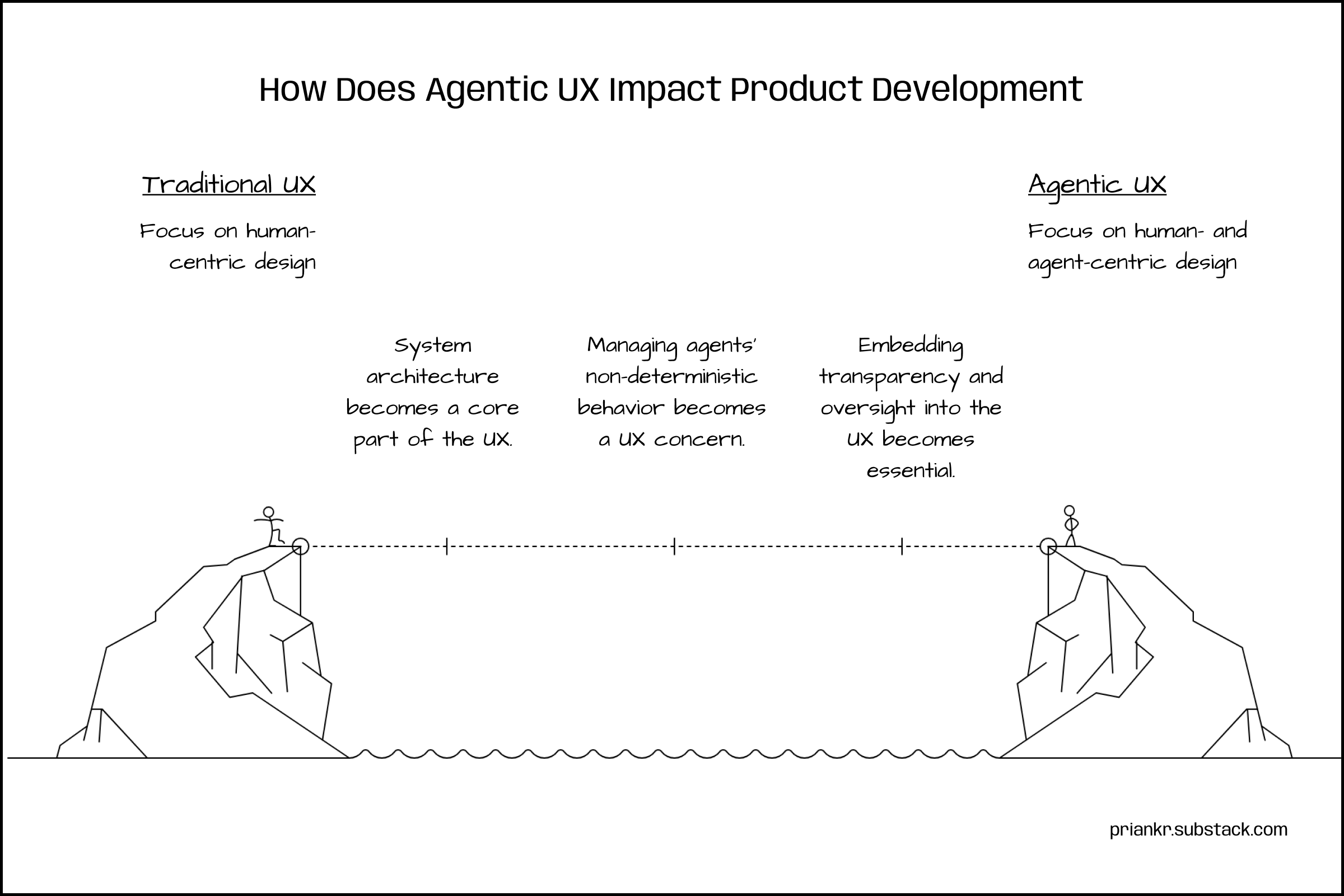
How Does Agentic UX Impact Product Development
System architecture becomes a core part of the UX.
Products have traditionally been designed for human users. When people interact with applications, they rely on visual cues (e.g., text, buttons, icons) to navigate the interface, make decisions, and perform actions. Therefore, product teams spend a lot of time and effort ensuring that the user experience supports the user journey. They ensure the product looks, feels, and functions great. However, a product’s polished interface does not always reflect the state of the underlying architecture.
Architectural issues that companies can largely ignore when serving human users become major problems when agents interact with the system. For example, a product might have an exceptional UI but incredibly messy code (e.g., mislabeled schemas, confusing internal tools/functions). These issues are largely invisible to human users, so many companies operate just “fine” under these conditions. However, agents rely on this underlying architecture to navigate the system, making these problems critical usability barriers.
When an agent interacts with an application, it ignores all the visual cues and circumvents carefully designed user flows. Instead, it examines information from the system, such as variable names, database schemas, function calls, etc., so architectural inconsistencies or issues now become usability concerns. If the agent can’t effectively interpret what to do, it will fail to use the product as intended, frustrating the people directing the agent. This will likely lead them to choose products that their agents can successfully interact with.
Managing agents’ non-deterministic behavior becomes a UX concern.
Autonomous task completion doesn’t always mean successful task completion because agents don’t consistently act in users’ best interests, leading to bad outcomes in some cases. They can give users the wrong information or make the wrong decisions when acting on their behalf. They can also misunderstand the context from the systems they are interacting with. These failure scenarios make it necessary to design systems that can accommodate the non-deterministic behavior of AI agents while still ensuring human end-users can get the expected outcome.
The agentic UX must recognize that the reliability issues with AI mean that agents can make mistakes. For example, a shopping agent might find the user the best deals, but if left unchecked, it may order the wrong thing, overcharge the user, or expose their payment details to suspicious websites. In scenarios where multiple agents interact, the primary agent the user interacts with might fail to catch mistakes made by the agents it’s directing. It may tell the user that everything is fine while issues go unnoticed until something goes very wrong.
Embedding transparency and oversight into the UX becomes essential.
Agents require users to surrender direct oversight and control to operate autonomously, but product teams need to consider how they distribute control between agents and users. The user does not necessarily need to confirm every single action, but the system needs to loop in the users during critical instances that have consequences (e.g., on their finances, on task success). Thoughtfully designing these specific moments (e.g., authorizations, confirmations) is more critical than making the entire app has a great UX.
Product teams must give users the ability to monitor, review, or override their agents’ actions. Users should be alerted at potential points of failure, and robust guardrails should be placed to minimize fallout. Users should be given the opportunity to intervene if and when necessary. Now this might make the experience less seamless, but it ensures that necessary friction is not automated away. When users lack visibility into what agents are doing within a platform, it’s hard to detect issues. Therefore, the UX must be designed to ensure users can understand the agent’s actions and spot instances when or where things go wrong.
You May Also Like: An Internet Redesigned for Machines
Why Understanding Agentic UX Matters Right Now
As more people use agents to interact with apps, teams must redesign their UX to ensure their product stays aligned with their users’ intent and desired outcomes.
Rising agent adoption will further distance people from the apps they “use.”
When users increasingly delegate tasks to agents, they no longer need to directly use applications to enjoy their benefits. This shift means product teams’ user experience priorities will need to shift from aesthetics to architecture to accommodate agentic “users,” in addition to (or even instead of) human users. Many apps now have their own agents. Since agents can also direct other agents, users might just instruct their single agent (e.g., their agentic browser, AI assistant) to orchestrate all the agent interactions and product interactions for them.
Users will prefer having a single agent orchestrate all their product interactions rather than managing multiple agents across different systems. This is already possible because of protocols such as the Model Context Protocol (MCP), which can help agents connect with different software applications, and the Agent2Agent (A2A) protocol, which can help agents connect with other agents While people might be able to use apps directly, many may choose not to, since their agents could access all the same functionality as well. The potential convenience will likely be too tempting for many people to ignore.
Designing for user intent will be critical for ensuring successful agent interactions.
When users no longer directly interact with applications, they lose visibility into the process and can only evaluate outcomes. Products are designed to solve specific problems for their target users. As agents become more mainstream, a lot of the “activity” on applications may soon be agentic rather than human. Customers may no longer care if the entire application has a great UX because they might just interact with some features, choosing to hand off many, if not most, tasks to agents. If users no longer directly use apps as much, they will evaluate their experience using the outcomes rather than the process.
Let’s say a customer uses an agent to shop on an app. Since they’re not ‘shopping’ in the traditional sense, they won’t see the curated selection, the incredible visuals, or personalized recommendations on the app. Their agent just goes on the app and finds the best match based on their requirements. All they see is what arrives at their doorstep. Therefore, their satisfaction with the app will be mostly based on their final order being successfully delivered.
This represents a fundamental shift from interface-centric to intent-centric design.
In a world where users increasingly delegate tasks to AI, the job of design is no longer to guide clicks and taps but to shape systems that understand and fulfill user intent. Goals define what users want to achieve, intent reveals why. Designing for agentic UX means building systems that recognize this distinction and act accordingly.
— Christopher Smith, How agentic AI enables a new approach to user experience design
Conclusion
Platforms will need to provide a seamless user experience regardless of whether people or their agents are using their product.
When users delegate entire workflows to agents, product teams lose the ability to guide them through traditional strategies. The technical debt hidden behind polished UIs will surface as external agents become more active on platforms. This new reality requires product, design, and engineering functions to collaborate more closely than ever to create a cohesive experience for all “users.”
Yet many companies that are building agents overlook how widespread agent adoption will change user behavior across all platforms. Product teams must recognize that architecture and interfaces must now work together to serve both humans and their agents. Companies that continue optimizing only for beautiful interfaces while neglecting the underlying systems that agents rely on will eventually lose customers to platforms where agents can operate successfully.
Treating this UX shift as a distant future problem is unwise. As agent adoption increases, users will evaluate products primarily by what they accomplish rather than how using the product feels. Everyone is building agents, so the competitive advantage will go to the platforms that create user experiences that enable agent use, along with mechanisms that ensure users can trust agentic actions.
Thanks For Reading
If you haven’t already, please consider subscribing and sharing this newsletter with a friend. I hope you have a great week!
References
Priank’s Newsletter | An Internet Redesigned for Machines, An Introduction To AI Agents, Evaluating How Well AI Systems Perform
EY Studio | How Agentic AI Enables a New Approach to User Experience Design
Standard Beagle | Agentic UX: Designing Interfaces for Agents
UX Collective | From Products to Systems: The Agentic AI Shift